


Appendices
Screening Toolbox
Case Studies
References
Privacy statementTerms of useThis website is for UK and Ireland Healthcare Professionals only.

CASE STUDY 1
Screening in a nurse-led community HIV clinic
Fictional case for illustrative purposes.
Patient history
- 60-year-old male living with HIV, MSM, lives with long-term partner
- HIV diagnoses: 1993 (nadir CD4 89 cells/mm3)
- HIV treatment: boosted protease inhibitor-based triple therapy (adherence challenging due to poor memory)
- Current status: CD4 383 cells/mm3 (12%), HIV viral load 4790 copies/mL
- Recent diagnosis with COVID — recovering
- COPD, TIA’s, low CD4 count and detectable HIV
- Treated Kaposi's sarcoma, tuberculosis and syphilis
Recent health-related problems
- Admitted to hospital with post COVID infection due to increased breathlessness, cough and pleuritic chest pain
- Diagnosed and treated for community acquired pneumonia
- Continues to experience reduced exercise tolerance
- Increased breathlessness
- Struggling to leave his 3rd floor flat for exercise and normal activities of daily living
- Becoming increasingly housebound and frustrated with his deteriorating quality of life
COPD = chronic obstructive pulmonary disease; MSM = men who have sex with men; TIA = transient ischaemic attack.
Using the “FRAIL in HIV” algorithm to screen for frailty framework
Result
Fatigue
Did they feel tired most or all of the time during the previous 4 weeks?
Yes = 1
Resistance (strength)
Any difficulty walking up 10 steps alone without resting and without aids?
Yes = 1
Ambulation (mobility)
Any difficulty walking several hundred meters alone with/without aids?
Yes = 1
Illness
More than five illnesses from this list: hypertension, diabetes mellitus, cancer, chronic lung disease, heart attack, congestive heart failure, angina, asthma, arthritis, stroke and kidney disease?
Yes = 1
Loss of weight
Weight loss of 5% or more?
No = 0
Score
4/5
Indicates frailty
Result
Home
Any issues happening at home? (Social, financial or support issues?)
Yes
Impairment
Any other physical or mental health challenge or limitation in daily functioning? Any new or change in impairment? Any pre-existing disability? (Body function/structure including symptoms, incontinence, pain, memory, cognition, other issues?)
Yes
Vulnerability
Anything else putting them at risk or making them less able to self-care or live well? (Polypharmacy/side effects, disability, mental health, mood/stress, stigma, alcohol/drug misuse, menopause, uncontrolled HIV, other worries?)
Yes
Interventions and outcome
- Fiercely independent man who doesn’t want to lose his independence
- 60 years old and doesn’t consider himself as old or frail
- Discussed referral to frailty team and considered as acceptable to maximise mobility and exercise tolerance
- Improved adherence using dosing device and adherence app on mobile phone
- Happy for referral as frailty considered reversible and he wanted to improve his quality of life
- Considered safe and discharged from hospital to home and awaiting review by community frailty team
CASE STUDY 2
Screening and assessment in a joint-HIV ageing clinic
Fictional case for illustrative purposes.
Patient history
- 77-year-old male living with HIV, MSM, lives with long term partner
- HIV diagnoses: 1991
- HIV treatment: boosted protease inhibitor-based triple therapy
- Current status: HIV well-controlled, undetectable
- Comorbidities: progressive multiple sclerosis, chronic inflammatory demyelinating polyneuropathy, epilepsy, treated hepatitis C with chronic liver disease, CKD, hypothyroidism and type 2 DM
- Medication history: polypharmacy — 7 additional non-ART drugs, including insulin
Recent health-related problems
- Recurrent falls with recent admission to emergency department with fall and head injury
- Decreasing mobility — now unable to manage stairs
- Worsening continence
- Cognitive decline
- Symptoms and signs of worsening liver disease
- Concern from partner that unsafe to be left alone — fear of falling
- Unmet care needs
Referred to a joint HIV-ageing clinic for frailty screening and assessment.
ART = antiretroviral therapy; CKD = chronic kidney disease; DM = diabetes mellitus; MSM = men who have sex with men.
Using the “FRAIL in HIV” algorithm to screen for frailty framework
Result
Fatigue
Did they feel tired most or all of the time during the previous 4 weeks?
Yes = 1
Resistance (strength)
Any difficulty walking up 10 steps alone without resting and without aids?
Yes = 1
Ambulation (mobility)
Any difficulty walking several hundred meters alone with/without aids?
Yes = 1
Furniture crawler indoors, wheelchair outdoors
Illness
More than five illnesses from this list: hypertension, diabetes mellitus, cancer, chronic lung disease, heart attack, congestive heart failure, angina, asthma, arthritis, stroke and kidney disease?
Yes = 1
Loss of weight
Weight loss of 5% or more?
No = 0
Score
4/5
Indicates frailty
Result
Home
Any issues happening at home? (Social, financial or support issues?)
Yes
Despite supportive partner, care needs exceed informal help
Impairment
Any other physical or mental health challenge or limitation in daily functioning? Any new or change in impairment? Any pre-existing disability? (Body function/structure including symptoms, incontinence, pain, memory, cognition, other issues?)
Yes
Vulnerability
Anything else putting them at risk or making them less able to self-care or live well? (Polypharmacy/side effects, disability, mental health, mood/stress, stigma, alcohol/drug misuse, menopause, uncontrolled HIV, other worries?)
Yes
Interventions and outcome
- Admitted to an intermediate care setting owing to complexity
- ~ART switched to a non-boosted regimen to enable wider co-medication review and optimisation
- Falls
- ~Postural hypotension identified — medications modified
- ~Frequent hypoglycaemia contributing to falls — insulin reduced
- ~Physiotherapy for strength and balance
- Decompensated chronic liver disease identified
- ~Decided further investigation and treatment too much — would worsen blood pressure, OGD too invasive
- ~Advanced care planning begun with him and partner
- Unmet care needs
- ~Largely around mobility, continence and cognition
- ~Formal package of care started — partner had confidence to go to work
- Frailty syndromes (falls/mobility/incontinence) modifiable but frailty less likely to be reversed here
- ~Pragmatic decision making due to end-stage liver disease
ART = antiretroviral therapy; OGD = Oesophago-Gastro-Duodenoscopy.
CASE STUDY 3
Screening and assessment in a HIV clinic
Fictional case for illustrative purposes.
Patient history
- 74-year-old, MSM, living with HIV
- Lives alone
- Diagnoses: 1987 (nadir CD4 49 cells/mm3)
- HIV treatment: boosted protease-inhibitor-based triple therapy
- Current status: CD4 565 cells/mm3 (35%), HIV viral load <40 copies/mL
- Treated PCP (at diagnosis)
- COPD, ischaemic heart disease and hypertension
Recent health-related problems
- Low mood
- PTSD from loss of two partners and multiple friends due to AIDS-defining illness
- Owns own home (ground floor garden flat)
- Managing activities of daily living but finding polypharmacy challenging
ADL = activity of daily living; COPD = chronic obstructive pulmonary disease; MSM = men who have sex with men; PCP = pneumocystis pneumonia; PTSD = post-traumatic stress disorder.
Using the Modified Fried Score to screen for frailty
In the last 12 months have you noticed any of the following:
Result
Inability to grip with hands (e.g., opening a jam jar)
N
Unexpected decrease (loss) of weight that’s worrying you
N
A slower walking pace than usual
Y
Not feeling full of energy most days of the week
Y
Being less or much less active compared with someone who spends 2 hours on most days on activities such as walking, gardening, household chores, or do-it-yourself projects
Y
Assessed as 'living with very mild frailty' with a score of 4 using the clinical frailty scale.
Interventions and outcome
- Referred into multidisciplinary HIV/frailty service
- HIV clinician, geriatrician, and HIV pharmacist identified possible DDIs and were able to switch ART to remove booster
- Recommendations made to GP to simplify antihypertensives (particularly with considerations of potentially fewer DDIs with the removal of ART booster)
- Physiotherapist offered referral to community service focussed on improving lung function but also to reduce cardiovascular risk
- Psychology referral made to help with mood and PTSD
- Individual cited staying in own home was a priority, but also felt isolated
- Self-referral to community organisation that supports older people living with HIV suggested
ART = antiretroviral therapy; DDI = drug-drug interaction; PTSD = post-traumatic stress disorder.
CASE STUDY 4
Screening, assessment and treatment in an outpatient physiotherapy clinic
Fictional case for illustrative purposes.
Patient history
- 51 year old woman, Black African, living with HIV
- Diagnosis: January 2020 (CD4 3 cells/mm3)
- HIV treatment: dual ART with integrase inhibitor + NRTI
- Current status: viral load <20 copies/mL, CD4 160 cells/mm3 (November 2022)
- Comorbidities: Kaposi’s sarcoma, falls
Recent health-related problems
- Hospital and intensive care admission 2022
- Required prolonged hospital admission and received multi-disciplinary care from medical, nursing and allied health professionals
- Cognitive health related challenges with memory and executive function
- No-fixed abode
- Provided with temporary housing
- Receiving two daily reablement package of care following hospital admission to assist with personal and domestic activities of daily living
- Mobilises with a walking stick
Screening using the Clinical Frailty Scale
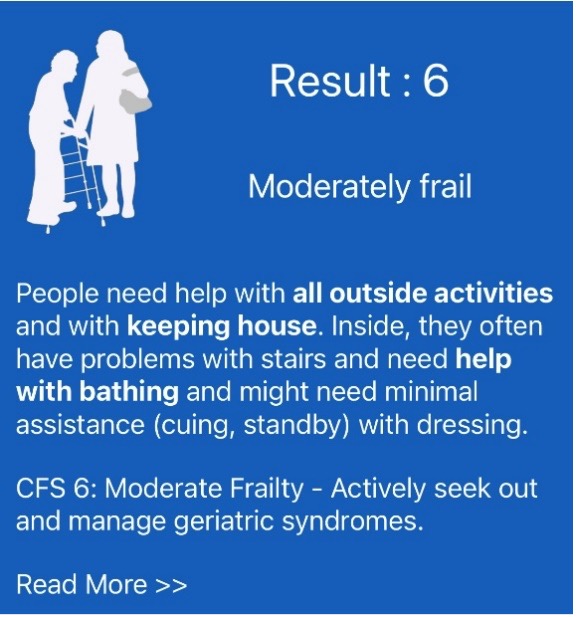
- Clinical Frailty Scale app used to screen for frailty
- Score = 6 (moderately frail)
Assessing functioning and disability
- Functioning and disability assessed subjectively using World Health Organization Disability Assessment Schedule 12-item self-reported questionnaire (WHODAS 2.0)
- ~Complex Sum Score = 58.33% (higher score = more disability experienced)
- Functioning and disability assessed objectively using gait speed and 5 x Sit-Stand test
- 6m Timed Walk Test:
- ~Time = 14.6 seconds with x1 walking stick
- ~Speed = 0.41m/s
- ~Impression: limited community ambulator, increased falls risk, dependent on activities of daily living
- 5 x Sit-Stand Test:
- ~Time = 14.6s with bilateral upper limb support
- ~Impression: reduced lower limb strength, balance and function
Interventions and outcome
- Referred to community rehabilitation services for strength, balance and mobility progress programme in the home environment
- Disability report provided to support with social security/benefits applications (e.g., person independence payments — PIP)
- Continued engagement with outpatient Physiotherapy services virtually (phone) to provide support, advocate for access to services including care, rehabilitation and equipment as required, and to support with progression of rehabilitation interventions to optimise independence with walking and personal care
- Referred to peer support services and health advisors
- Referred to housing and social services to support with housing and financial security