



Screening Toolbox
Our top questions for identifying those at risk

Do you find yourself taking longer to do things, needing more support at home or facing issues getting out of the bath, dressing yourself independently or standing up from a chair without using your hands?*†

How are your energy levels at the moment? Do you ever feel extremely tired or exhausted for no reason? Are you worried about your mood or your memory?†

Have you fallen in the last year or do you feel you’ve been falling unexpectedly recently?

Are you happy with everything at home — any social or financial worries? Do you have someone at home or nearby to support you if needed?

Have there been any changes with the medicines you take since I last saw you — anything new, changed, stopped or causing you issues?

Is there anything worrying you as you’re getting older, e.g., incontinence issues? Or any other health problems that are on your mind or affecting you at the moment?†
†Insight into these aspects could be captured simply by observing an individual’s movement and behaviour, particularly if you know them well and understand what’s normal for them.
FRAIL in HIV Training Poster
Many complex factors can put someone living with HIV at risk of frailty (or being less able to age well), and they aren’t always functional or physical. Look beyond physical signs of frailty, such as those outlined by the F.R.A.I.L. scale*…
…And also consider other risk factors in the context of H.I.V.:
Social, financial, support issues?
Body function/structure including symptoms, incontinence, pain, memory/cognition, other issues?
Polypharmacy/side effects, disability, mental health, mood/stress, stigma, alcohol/drug misuse, menopause, uncontrolled HIV, other worries?
Refer to the F.R.A.I.L. in H.I.V. screening example for a more detailed example of how to use this framework in practice.
Although not yet evaluated in people living with HIV, the FRAIL scale has been recommended by EACS* to be used as a screening tool for frailty in people living with HIV. The FRAIL in HIV framework builds off the FRAIL scale; the framework has not been validated in any population and is not endorsed by any professional organisation.
F.R.A.I.L. in H.I.V. screening example
This is an example of how the ‘FRAIL in HIV’ framework could be used to screen patients as part of an annual health review or during a focussed ‘screening’ initiative. As well as the framework, there are suggested possible questions and supporting tests that may help you to identify key risk factors that may indicate risk of frailty.
- Do you feel more tired than normal?
- Have you felt more tired than normal over the past 4 weeks (or 1 month)?
- Can you walk up 10 steps alone without support?
- Timed-Up-and-Go (≥12 secs = higher risk of falls)
- 5x Sit-to-Stand (>14 secs = higher risk of falls)
- Do you have any difficulty walking several hundred metres alone with/without aids?
- Gait speed (≤0.8 metres/second = frail)
Hypertension, diabetes mellitus, cancer, chronic lung disease, heart attack, congestive heart failure, angina, asthma, arthritis, stroke and kidney disease
- How many significant long-term conditions or illnesses do you have?
- Have you experienced any unexplained sudden or noticeable loss of weight recently?
- Measure weight (>5% loss = frail)
- How are things at home?
- Do you have/have you had any concerns recently?
- Do you have any financial worries on your mind?
- Do you have anyone at home or nearby to support you if needed?
Body function/structure including symptoms, incontinence, pain, memory/cognition, other issues?
- Do you have any issues getting out of the bath or dressing yourself independently?†
- Do you find yourself taking longer to do things or do you need more support or help at home?
- Are you worried about your mood or your memory?
- Is there anything worrying you as you’re getting older? Are there any other health problems that are on your mind?
- Has anything changed with the medicines you take since I last saw you — new, stopped, changed or any issues?
Polypharmacy/side effects, disability, mental health, mood/stress, stigma, substance abuse, menopause, uncontrolled HIV, other worries?
*Based on European AIDS Clinical Society Guidelines version 11.1 (October 2022).
†N.B.: Disabilities should be taken into consideration when performing any tests or screens for frailty.
Illustrative ‘FRAIL in HIV’ framework
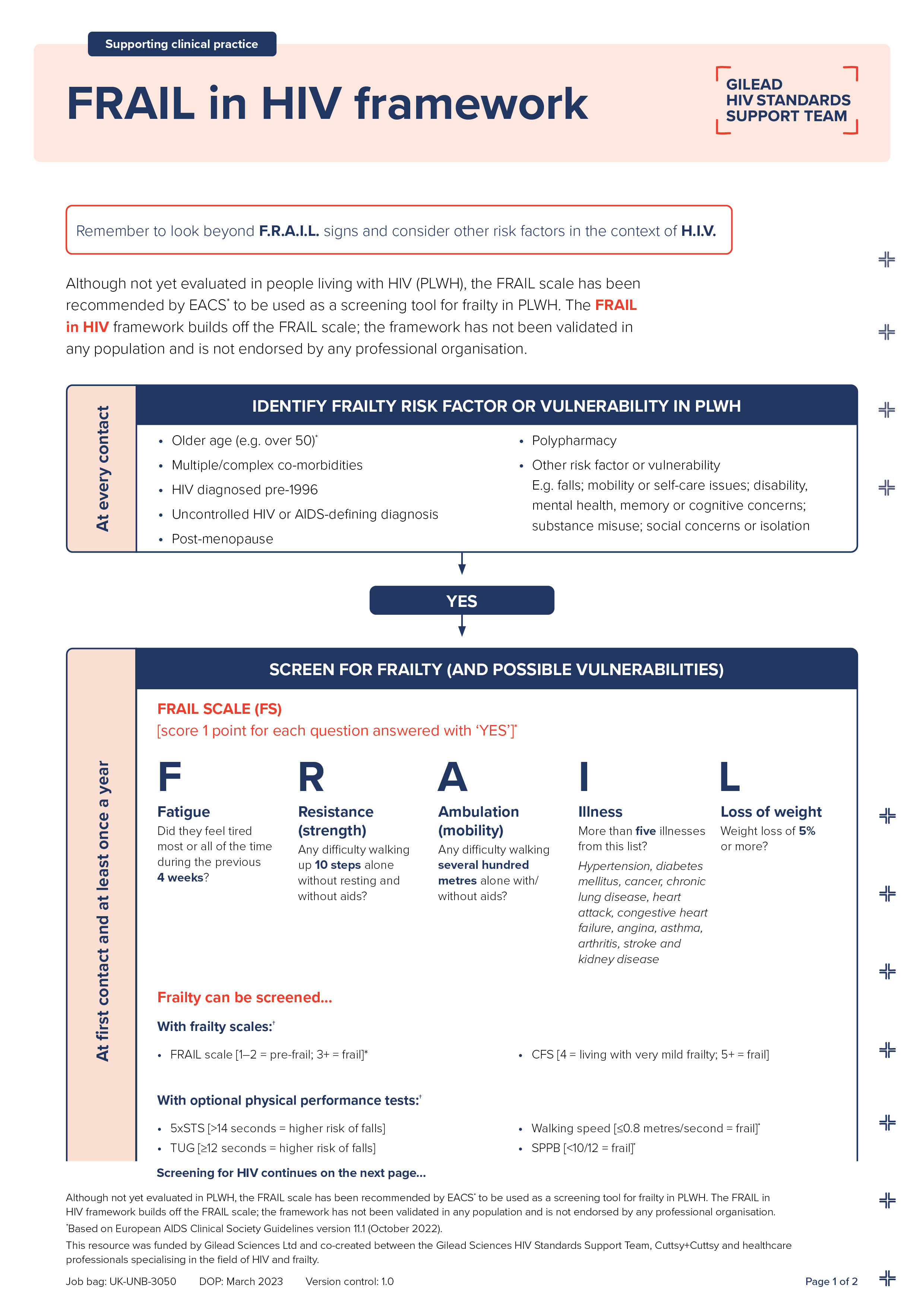
Although not yet evaluated in people living with HIV, the FRAIL scale has been recommended by EACS to be used as a screening tool for frailty in people living with HIV. The FRAIL in HIV framework builds off the FRAIL scale; the framework has not been validated in any population and is not endorsed by any professional organisation.
The framework is meant to be illustrative. It aims to provide enough of a guide for services to follow in practice while still allowing flexibility for centres to choose a screening and assessment approach that fits best with their setting and the needs of their cohort.
The information is meant to be more indicative and illustrative of the elements that should be covered and measured as part of screening for frailty.
Some people may not need to formally measure, but for those that do, there is a list of available tools that can be used to measure various elements to 'build the picture' and make a holistic decision about next steps.
You will be able to access the various tools mentioned in the framework via the hyperlinks including in this guide.
HCP toolbox
It is useful to review the various resources and determine which will be most useful and practical for your practice setting.
Click on the links to learn more about each resource. Please note that each link will take you to a third-party website. Gilead does not endorse or accept liability for sites controlled by third parties.