



Identifying frailty risk in people living with HIV

What are the risk factors?
A combination of biological and environmental factors can contribute to the development of frailty in people living with HIV.2


More research is needed to understand what poses the greatest risk and how the different factors influence each other. But as a general rule, as the complexity of someone’s situation increases, so do the risks.
Living with HIV in itself puts people at risk of developing signs of frailty earlier in life and a number of specific aspects contribute to this picture:6,11
- The length of time that someone has lived with HIV
- How well controlled it has been during that time and their body’s response to it
- A low CD4 count has been shown to be one of the strongest predictors of frailty compared with other HIV factors.6 Low CD4 is the most consistently reported HIV factor associated with frailty, with current CD4 more predictive than nadir count12
- Which HIV medicines they have taken and for how long
- Being treated before 1992 or before the broader implementation of HAART in 1998 may have exposed people to the additional burden that less tolerable or less effective medications posed compared with the therapies in use today
Frailty appears to develop at a younger age among people living with HIV versus the general population.13 Prevalence data for those living with HIV aged 50 or older found:14
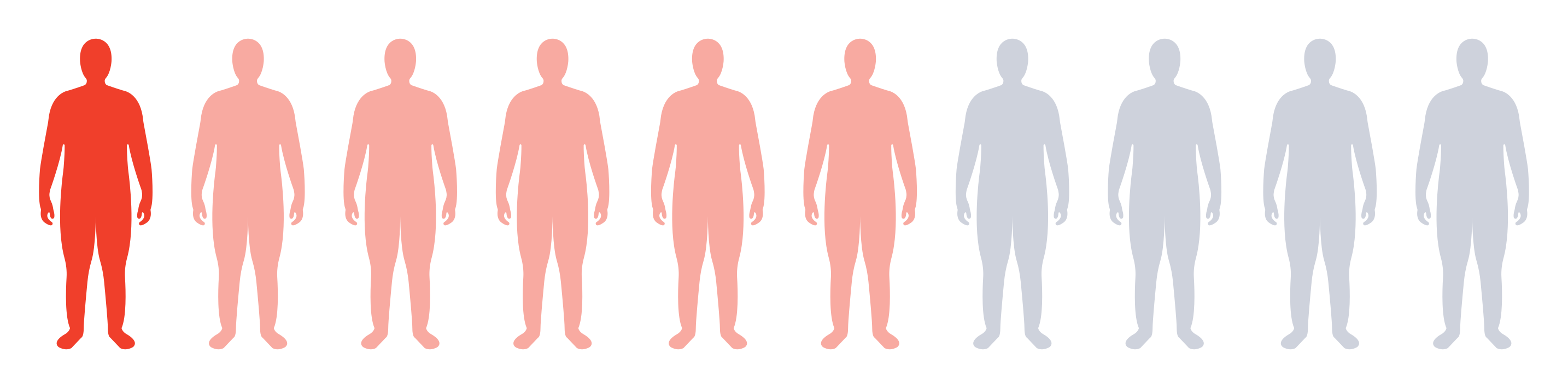
- At least 1 in 10 (10.9% [95% CI, 8.1–14.2%]) were living with frailty and
- Almost half (47.2% [95% CI, 40.1–54.4%]) were living with pre-frailty
And for the whole population living with HIV:
- The total prevalence of frailty may be between 4 and 10%*13
Frailty is primarily seen as an age-related condition because, in the absence of HIV, natural progression towards a frailty syndrome correlates most accurately with age. But this may not always be the case within the HIV population due to wider variation in health complexity across age groups. Existing literature and guidance typically suggests monitoring for signs of frailty in those aged 50 or over15,16 but, given the role of other biological and HIV factors, younger people shouldn’t be excluded from screening based on age alone.
Living with multiple conditions is a risk factor for frailty regardless of whether someone is also living with HIV. However, given that people living with HIV are disproportionally affected by co-morbidities and have a high prevalence of disability compared to the HIV-negative population, multiple co-morbidities play a dominant role for this group.17–19


Medications may contribute to the development of frailty either through direct effects or via drug-to-drug interactions.22 With co-morbidities being common among people living with HIV, many live with a long-term burden of non-HIV medication that must also co-exist effectively alongside their antiretroviral regimens.
If an individual is on multiple medications, and particularly if they are experiencing side effects or drug-to-drug interactions (DDIs), they may present as exhibiting signs of frailty.
Antiretroviral (ART) medication has come a long way. Today’s HIV treatments have improved in effectiveness, tolerability23 and cause fewer DDIs as we move away from protease-inhibitor-based regimens.24 However, there are still some drug combinations that should be avoided.
For further information about DDIs, visit University of Liverpool’s HIV Drug Interactions Checker and always consult the summary of product characteristics of the medicines.
Deprescribing is a process of withdrawing medicines to try and improve outcomes for a patient. It is gaining more attention as HCPs are caring for an ever-ageing population with complex clinical needs due to comorbidities and polypharmacy.25
One of the key ways to manage signs of frailty is to perform a medication review to ensure that an individual's treatment is optimised. This can provide the opportunity to consider deprescribing medicines. However, any decision to withdraw a medicine should be carefully assessed for potential risks and benefits to ensure that ultimately the patient's medical conditions continue to be safely and effectively managed.25
Refer to the STOPP/START criteria, which is an evidence-based screening tool used to review medication regimens in elderly people.

In addition, ageing also affects how medicines are metabolised, distributed, and eliminated from the body. This means older people living with HIV may be exposed to higher levels of drugs, more interactions and greater toxicity, if medications aren’t reviewed and optimised regularly.22 Therefore, care should be taken if someone living with HIV on ART medication is also on any other medication.
Among adults living with HIV, aged over 50 years, women have been shown to have worse physical function and lower quality of life compared with men, despite having a better immunologic recovery.26 In a cross-sectional, self-reported study in people living with HIV, identifying as a woman was an independent risk factor for higher HIV disability questionnaire severity scores across “physical”, “mental and emotional”, “uncertainty” and “social participation” domains.19
Women living with HIV also experience more rapid declines in bone mineral density27 and have an increased cardiovascular risk,28 compared with men. Menopause in this population is still poorly understood, and many HIV physicians lack experience in managing it, meaning many women are unable to access appropriate care.29 Menopause can also exacerbate symptoms like muscle aches and fatigue in women living with HIV, irrespective of age.30

Moderate to severe depression has been consistently found to be present at higher levels among individuals living with HIV who are frail compared with those who are not frail.6,13
- Non-Hispanic Black ethnicity31
- High BMI32 and low BMI13
- Cognitive impairment13
- Lower socioeconomic status13,33
When and where to screen?
Helping individuals age well is already becoming part of everyday practice, particularly as the average age of our cohorts continues to rise. But to make sure signs of growing complexity or vulnerability are managed efficiently, it’s important that clear processes are in place to look for them. Screening for frailty in people living with HIV is encouraged by EACS15 and IAS.16

Looking for signs of frailty or growing complexity should ideally happen at every encounter. In particular, the first 6 to 12 months post-diagnosis can be acutely complex. Any indication of growing complexity, whether or not obvious mobility or functional decline is present too, should then prompt further investigation. For example:
- Further questioning in the moment
- A follow-up call or visit
- A pre-clinic call or questionnaire before the next session
- An offer of a longer, more comprehensive assessment, either straightaway or at the next appointment
While there are various opportunities for proactive screening and each strategy has a role, individual services need to establish which option(s) will work best for them in clinical practice.

It may also be useful to establish set scenarios when individuals may be routinely screened for frailty or potential risk factors. This helps lower the chance of something being missed. A routine screen could be part of:
- An annual health review; and/or
- A new patient registration or new referral

The development of frailty is multifactorial and therefore not unique to just one age group or one clinical factor.
However, for services with large or complex cohorts, routinely screening a subset of patients first based on the most significant risk factors may help you build-up experience and introduce processes in a manageable way rather than trying to address everyone at once.
- Triage patients during their routine review
- Discuss the risk of frailty with patients
- Consider onward referral for assessment


A pre-appointment frailty screen or longer assessment appointment could be offered to these highest risk groups prior to routinely screening others within the cohort.

Many people who are frail, or at risk, may be experiencing challenges that can pose a barrier to engaging with services or attending appointments in person. Some may struggle with technology, while others may be overwhelmed by intensive questioning. Additional consideration is needed to ensure we conduct screening appropriately for those who may speak little or no English so they can understand what will happen and why. We also don’t want to put off those currently less at risk, in case they disengage later on. That’s why flexible screening is important.
Offering home visits may help to improve access for those with disabilities and other vulnerabilities.
Introducing simple screening questions as part of a pre-appointment check-in may be useful for those who struggle to engage with appointment or digital technology. This could be supported by community nurses or healthcare assistants.
Conducting frailty screens as part of virtual consultations may help to reduce missed appointments by offering flexibility for these more holistic sessions that may seem less related to routine HIV care.
How to identify or screen those at risk?
There is currently no consensus on the best way to screen people living with HIV to identify who may be living with, or at risk of, frailty and therefore benefit from a more comprehensive frailty assessment.
There are many tools to identify or screen for frailty. Here are a few of the traditional screening approaches available:



Other single performance tests exist37 which may be of use in screening for frailty in people living with HIV, including grip strength test38 and floor transfer test.39
While current frailty tools may be helpful as a reference or be part of a service’s standard practice, they are not without fault. Most haven’t been specifically designed for, or fully validated in, people living with HIV. Some are too simplistic, focussing only on physical signs of frailty, while others are too cumbersome to use in practice. There are caveats to interpretation, too. For example, it is important to make sure that poor results from physical performance tests are not caused by a single underlying issue (weak arm, leg, etc.). When combined with lack of awareness and time within clinics, unique vulnerabilities and growing complexities among people living with HIV are easily missed.
Various factors may limit someone’s ability to age well while living with HIV (thereby putting them at risk of frailty), and they aren’t always physical or functional. Screening in this population should therefore take a more holistic approach to ensure relevant risk factors are recognised and a comprehensive assessment offered as early as possible. Looking for signs at every encounter, including the first, will limit people falling through the net and give them the best chance of ageing well while living with HIV. Observing how people behave in everyday settings, whether at home or in a waiting room is also good practice. Simple questions can also be included as part of everyday practice.
Limited time for tests? See our Top questions to ask to find those at risk.
Introducing the ‘FRAIL in HIV’ framework
The ‘FRAIL in HIV’ framework has been created to provide you with a more holistic and memorable way of identifying those who may be at risk of frailty across your HIV services.
It encourages you to look beyond physical signs of frailty, such as those outlined by the F.R.A.I.L. scale*…
Hypertension, diabetes mellitus, cancer, chronic lung disease, heart attack, congestive heart failure, angina, asthma, arthritis, stroke and kidney disease
…And also consider other risk factors in the context of H.I.V.:
Social, financial, support issues
Body function/structure including symptoms, incontinence, pain, memory/cognition, other issues
Polypharmacy/side effects, disability, mental health, mood/stress, stigma, alcohol/drug misuse, menopause, uncontrolled HIV, other worries
You can also refer to the illustrative ‘FRAIL in HIV’ framework and Frailty screening example in the Practical Resources for a more detailed example of how to use the framework in practice.
*Based on European AIDS Clinical Society Guidelines version 11.1 (October 2022).
Regardless of the outcome of the frailty screen, any issues or vulnerabilities identified by the ‘H.I.V.’ acronym or equivalent questioning should be noted and explored further, as soon as possible, by a relevant service. Providing additional care to limit or manage ongoing vulnerabilities will help optimise an individual’s ability to age well and minimise the risk of frailty developing over time.

Various factors may limit someone’s ability to age well while living with HIV (thereby putting them at risk of frailty), and they aren’t always related to physical health or functioning
Everybody can play a part in looking for relevant risk factors, including GPs, healthcare assistants, HIV consultants, nurses and others involved in care
Taking a consistent, holistic approach to screening, even if it’s question-based, is more important than relying on a frailty screening tool
Always give individuals space to raise their own concerns and remember to watch and listen to how an individual is doing generally
Disabilities, either visible or invisible, should be considered when interpreting the results and responses during screens, assessments and performance tests
Looking for risk factors at every encounter, including the first, gives you the best chance of identifying and managing issues before someone becomes frail